
College fest games ideas: 7 formats you can run
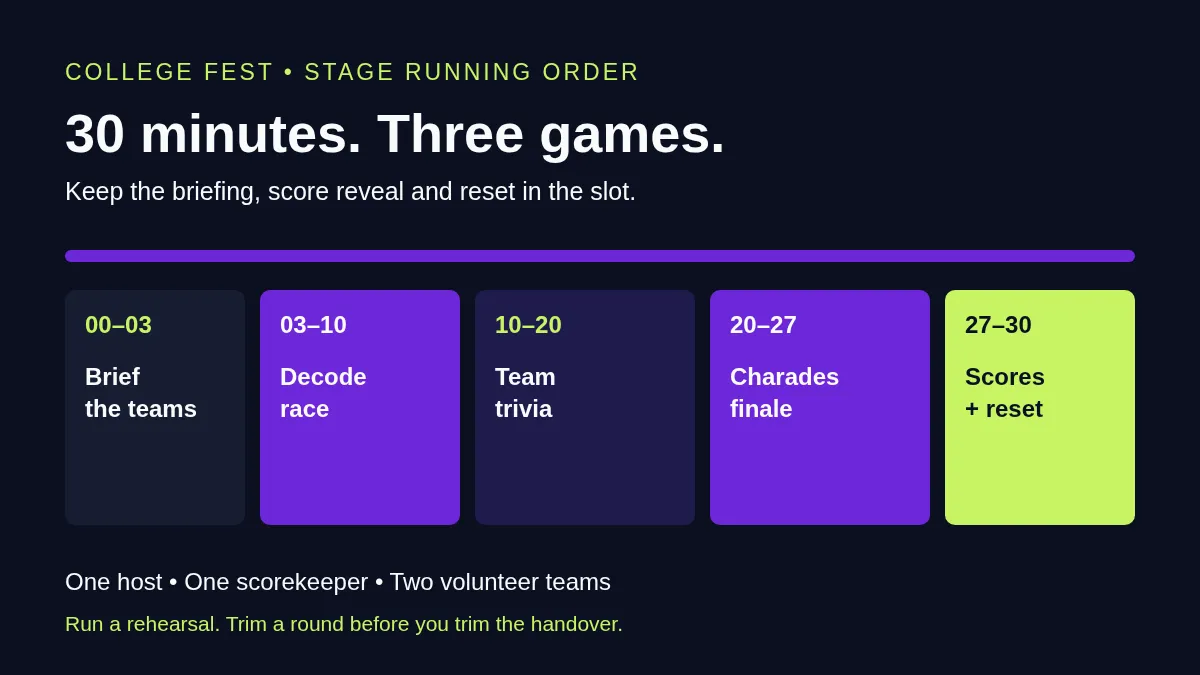
For college fest games ideas you can run with a small crew, start with a decoding race, team trivia or dumb charades. Choose a cooperative puzzle for a quieter group, a secret-role game for a small circle, or a treasure hunt when you have time to prepare a campus route. Pick one main format and a short backup, then rehearse the rules, scoring and handover before the crowd arrives.
Choose college fest games ideas by space and participation
Decide whether everyone should play at once or a few volunteers should perform while the crowd watches. A stage game can entertain a hall without putting every attendee in the competition; a table puzzle needs enough materials for every competing team.
These are suggested starting formats and time budgets, not software capacity limits. The timings below cover play; allow extra time for explaining rules and announcing results.
| Game | Best setting | Suggested starting group | Play budget | What to prepare |
|---|---|---|---|---|
| Decoding race | Seated hall or club room | Teams of 3–5 | 5–8 minutes | Cipher sheets, answer slips, answer key |
| Team trivia | Hall with a host | Teams of 3–5 | 8–12 minutes | Questions, answer sheets, visible scores |
| Dumb charades | Stage with a clear acting area | Two teams, one actor at a time | 5–8 minutes | Private prompts and a timer |
| Cooperative control-panel puzzle | Tables or a small stage team | 3–5 players per team | 8–10 minutes | Puzzle board and separate rule cards |
| Secret-location guessing | Quiet circle | Five players plus a host | 6–8 minutes | Four matching location cards and one spy card |
| Tabletop escape challenge | Club room or activity booth | Teams of 3–5 | 15–20 minutes | Three linked puzzles and sealed hints |
| Campus treasure hunt | Approved walking route | Teams of 3–5 | 30–45 minutes | Clues, checkpoint markers and marshals |
For a short main-stage slot, choose decoding, trivia or charades. Save the hunt for a separate activity: teams leaving the hall won't help the next stage act start on time.
1. Run a decoding race with a solved practice clue
Give every team the same cipher and accept one written answer per team. Show a practice clue before starting the scored round so beginners understand the method.
For a Caesar cipher, each letter moves a fixed number of places in the alphabet. Say the practice message is IHVW, with the instruction “move each letter back three places.” I becomes F, H becomes E, V becomes S and W becomes T. The decoded answer is FEST.
Prepare three scored messages using the same shift. Award one point per correct message submitted before the deadline, with no speed bonus. That makes paper scoring manageable and prevents one disputed arrival time deciding the contest. Collect answers before revealing the key.
If nobody solves the practice clue, walk through another letter. Don't spend the scored round teaching a rule teams haven't understood.
2. Keep team trivia short and score it visibly
Use six questions across two or three topics. Include an accessible opening question, then mix campus knowledge with broader subjects so visitors can contribute.
- Read the question and show it on a slide if you have a screen.
- Give teams 30 seconds to discuss and write one answer.
- Call “pens down,” collect or check the slips, and reveal the answer.
- Award one point for a correct answer. Show standings after question three and question six.
Have a separate, checked tie-break question ready. State acceptable answer variants in the scorekeeper's key before play; don't improvise different standards for different teams.
3. Give dumb charades one unmistakable rule set
An actor reads a private prompt and acts without speaking while their own team guesses. For this short format, allow gestures for word count, but prohibit mouthing words, spelling letters and pointing at written answers.
Give each team two turns of 60 seconds, rotating actors. Award one point per solved prompt. Offer one replacement prompt before the timer starts if an actor doesn't recognise the title or phrase; once the timer begins, the turn stays with that prompt.
Use familiar titles or everyday actions, and match the difficulty across teams. Pick a host to decide rule breaches. Audience reactions can add energy, but a shouting contest shouldn't determine the score.
4. Split information in a cooperative control-panel puzzle
Give one player a paper panel showing symbols and numbered switches. Give the other players rule cards; they must explain their information aloud while the panel player records the final switch sequence.
For example, one card can say “the star switch goes before the circle,” while another says “the triangle is last.” A panel with star, circle and triangle has the answer star → circle → triangle. Build several panels, then check that every set of rules produces one answer.
Award a point for each correct panel completed within the round. Use a pretend control panel rather than a realistic suspicious package, and keep it at a staffed activity table. Before play, tell teams who can see the panel and whether rule cards can be shown or only described.
5. Keep secret-location guessing in a small circle
Hand four players cards naming the same place, such as “library,” and give the fifth a card marked “spy.” Players keep their cards private. The spy tries to infer the place from questions; the others try to identify who doesn't know it.
Run two questioning laps, with each player asking another player one question per lap. Questions should be indirect: “Would you normally talk loudly here?” works better than “Are we in a library?”
Then have everyone point to their suspect together. For this version, a unique highest vote identifies the accused player; a tied vote means the group fails to identify the spy. The group wins by identifying the spy, otherwise the spy wins. Rotate the spy card for the next round and don't add complicated scoring to the first rehearsal.
This format needs players to hear one another. On a loud stage, use microphones or choose a different game.
6. Build a tabletop escape challenge with checked answers
Use three linked puzzles: a symbol key reveals a word, that word identifies an envelope, and the envelope contains the final logic puzzle. Keep every clue on the table so teams don't need to search the building.
Let teams request up to two sealed hints. Add one minute to a finishing team's elapsed time for each hint opened, and explain that penalty before play. Rank finishers by adjusted time; if the round ends with unfinished teams, rank those teams by the number of puzzles completed.
Ask someone who didn't write the puzzles to test them. If two answers look equally valid, rewrite the clue before printing. Duplicate every team's materials and keep a replacement set with the marshal.
7. Use a campus treasure hunt only after walking the route
Choose four permitted checkpoints on a walking route and put one marshal at each checkpoint. Each solved clue leads to the next marker; a marshal records arrival and gives the team its next clue. Start teams at different checkpoints in a loop, then send each team back to its own starting point to finish.
Walk the full route with the venue team. Avoid roads, locked areas, active classes and places where teams could block access. Offer a step-free route and a seated puzzle alternative, and publish a finish time and contact point for teams that stop early.
Use arrival records or completed checkpoints for scoring, not running speed. If a checkpoint closes, tell every team about the same replacement task. Keep the hunt out of a stage slot unless the stage programme explicitly allows the time away.
Fit three games into a 30-minute stage slot
Say your committee has one host, one scorekeeper and two volunteer teams of four. The audience watches the decoding and trivia rounds, then cheers the charades finale.
| Slot | Host action | Scorekeeper action |
|---|---|---|
| 00–03 | Introduce teams, explain points and run the practice cipher | Hand out labelled answer sheets |
| 03–10 | Run three decoding messages and reveal answers | Record up to three points per team |
| 10–20 | Run six trivia questions | Record up to six points per team |
| 20–27 | Run four charades turns, two per team | Record up to two points per team |
| 27–30 | Reveal totals, use a tie-break if needed, hand over the stage | Confirm totals out of eleven and clear materials |
Tell teams in the briefing that trivia contributes more points than either other game. Keep the same teams throughout so you don't lose time recruiting new volunteers.
Rehearse this running order with a stopwatch. If it overruns, remove a trivia question and update the maximum score; protect the final three minutes for results and handover.
Prepare a recovery plan before opening the round
- Keep printed questions, cipher sheets and a paper score grid beside the host. If a display or connection fails, stop the clock and explain how play will continue.
- Ask a volunteer at the back of the room to check slide readability and audio during rehearsal.
- Give one person final authority over disputed answers, using the prepared key. Let the scorekeeper handle records while the host addresses the room.
- Let attendees watch without joining, and let a volunteer pass on performing. A lively crowd doesn't require every student to take the stage.
Rehearse a browser-based format with your crew
FestForge is our browser-based college-fest games platform, with host controls, shared-screen action and phone participation without an app download. Explore the playable games and setup requirements, including cooperative bomb puzzles, decoding, charades and secret roles. A free organiser account lets you rehearse each new game with up to five participants total across all teams; Spy Among Us needs all five.